
S-Corp Tax Filing for Dallas Construction Owners: Build Your Wealth, Not Your Tax Bill

S-Corp Tax Filing for Dallas Construction Owners: Build Your Wealth, Not Your Tax Bill
- Why Your Entity Structure is Holding You Back
- Partnership Tax Return Preparation for Multi-Owner Trades
- Complex Entity Structures: Protection and Optimization
- The "Texas Factor": Franchise Tax and Compliance
- Job Costing: The Backbone of Construction Bookkeeping
- Why a CPA Dallas Specialist is Essential
- Moving Toward Scalable Growth
Why Your Entity Structure is Holding You Back
Most construction businesses start small. You might have started as a "man with a van" or a specialized subcontractor. In those early days, a simple Limited Liability Company (LLC) or a DBA served its purpose. But as you hire crews, purchase heavy equipment, and take on larger contracts, that simple structure becomes a liability.
When you operate as a standard LLC or sole proprietorship, every dollar of your profit is subject to self-employment tax (currently around 15.3%). Once your construction business clears $200,000 in revenue, that tax bill becomes a significant drain on your cash flow.

The Transition to S-Corp Tax Filing
For a Dallas-based construction company, electing to be treated as an S-Corp can be a game-changer. By using an S-Corp structure, you separate your business income into two categories:
- A "Reasonable Salary": You pay yourself a W-2 wage, which is subject to payroll taxes.
- Distributions: The remaining profit is passed through to you as a distribution, which is not subject to self-employment tax.
This strategy alone can save DFW trades owners thousands: sometimes tens of thousands: of dollars every year. However, s corp tax filing requires precision. The IRS frequently audits construction firms on the definition of a "reasonable salary." We help our clients find that "sweet spot" that maximizes savings while remaining fully compliant.
Most construction businesses start small. You might have started as a "man with a van" or a specialized subcontractor.
Partnership Tax Return Preparation for Multi-Owner Trades
Many successful electrical, plumbing, or HVAC firms are owned by multiple partners. In these cases, the tax landscape shifts to Form 1065 and Schedule K-1.
Partnership tax return preparation for construction firms is notoriously complex due to the way income and losses are allocated. If your partnership is investing in new machinery or taking on debt to finance a large project, these factors must be meticulously tracked to ensure each partner’s basis is calculated correctly.
Inaccurate basis tracking is one of the fastest ways to trigger an IRS inquiry. At AG Freideman, we ensure that your partnership returns reflect the reality of your operations, protecting the individual owners while optimizing the firm's overall tax position. You can learn more about how we handle these complexities through our tax preparation services in DFW.
Complex Entity Structures: Protection and Optimization
As your construction empire grows, a single entity might not be enough. We often advise high-revenue clients to consider complex entity structures. For example, you might have an operating company (the S-Corp that handles the contracts and labor) and a separate holding company or equipment leasing company.
This "parent-subsidiary" or "brother-sister" setup serves two purposes:
- Asset Protection: By keeping expensive excavators, trucks, and specialized tools in a separate entity from the operating company, you shield those assets from potential litigation or creditors associated with a specific job site.
- Tax Efficiency: You can lease the equipment from your holding company to your operating company, creating deductible expenses and shifting income in a way that minimizes the total tax burden of the owners.

The "Texas Factor": Franchise Tax and Compliance
While Texas is famous for having no state income tax, Dallas construction owners are not entirely off the hook. The Texas Franchise Tax (often called the Margin Tax) applies to most entities, including S-Corps and Partnerships.
For 2024 and 2025, the "no-tax-due" threshold is approximately $2.47 million in total revenue. If your construction firm earns more than this, you must file a comprehensive franchise tax report. Many business owners in the Metroplex mistakenly use the "E-Z Computation" method, which carries a flat rate of 0.331%. However, we often find that calculating the tax based on "Cost of Goods Sold" (COGS): which is substantial in construction: can lead to a lower tax liability.
Managing these state-level filings is a core part of our franchise tax report filing service.
Job Costing: The Backbone of Construction Bookkeeping
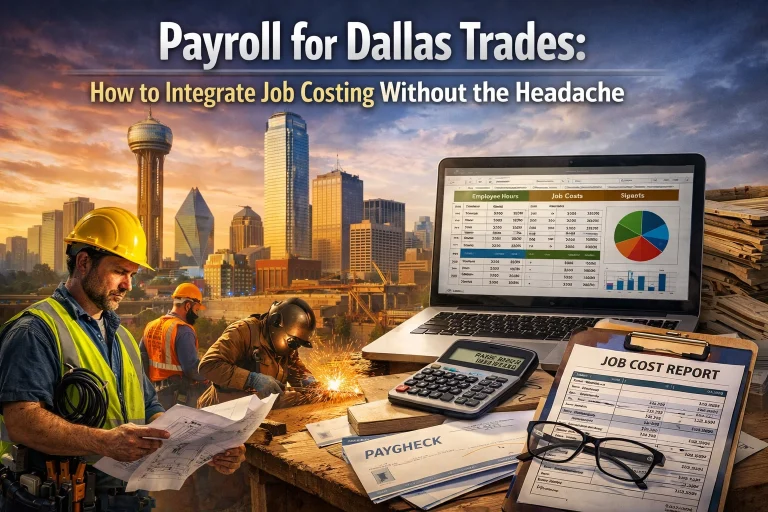
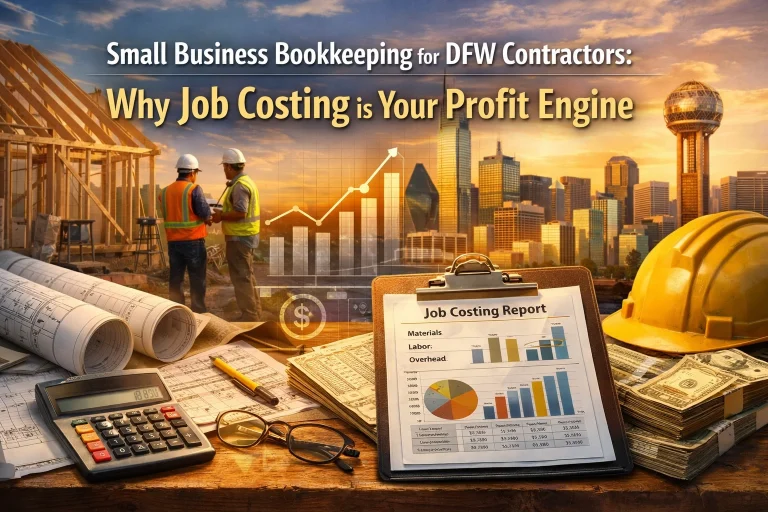
You cannot have effective tax planning without accurate bookkeeping. In the construction world, generic bookkeeping doesn't work. You need job costing.
Job costing involves tracking every dollar of labor, materials, and overhead back to a specific project. This is critical for several reasons:
- Profitability Analysis: Do you know which jobs are making you money and which ones are barely breaking even?
- Revenue Recognition: For larger projects that span across tax years, how you recognize income (Cash vs. Accrual vs. Percentage of Completion) significantly impacts your year-end tax liability.
- Audit Defense: If the IRS questions your deductions for "materials," having a clean trail of job-costed invoices is your best defense.
Our small business bookkeeping services are specifically designed to handle the nuances of the trades, ensuring that your financial data is "tax-ready" at all times.

Why a CPA Dallas Specialist is Essential
The DFW market is unique. Local regulations, municipal requirements, and the sheer pace of the local economy require a financial partner who understands the ground you're building on. A generic online tax software or a "neighborhood" tax preparer won't understand the nuances of Section 179 depreciation for a new Ford F-350 or the intricacies of the Qualified Business Income (QBI) deduction for a roofing contractor.
Working with a CPA Dallas professional team like AG Freideman means you get proactive advice throughout the year, not just a frantic phone call in April. We focus on:
- Quarterly Tax Projections: We look at your numbers every three months so there are no surprises on tax day.
- Nexus Issues: If your crews are crossing state lines into Oklahoma or Louisiana for jobs, we manage the multi-state filing requirements to keep you compliant.
- Entity Management: We can even serve as your Texas Registered Agent to ensure you never miss a legal notice or state filing deadline.
Moving Toward Scalable Growth
If your construction business is generating over $200,000 in revenue, you have moved beyond the "startup" phase. You are now managing a complex organization that requires a sophisticated financial strategy.
By prioritizing s corp tax filing and professional partnership tax return preparation, you stop viewing taxes as an unavoidable "fine" and start viewing them as a variable cost that can be managed and reduced.

We invite Dallas and Fort Worth construction owners to step away from the spreadsheets and back onto the job site. Let us handle the compliance, the job costing, and the complex tax strategies that keep your business profitable. Whether you need a full suite of virtual accounting services or specialized tax planning, our team is ready to help you build your wealth.
Your business builds the DFW skyline. We build the financial foundation that keeps it standing. Reach out to AG Freideman Tax & Accounting Firm today to discuss how we can optimize your construction tax strategy for the coming year.

Ready to Get Started?
Book your free consultation with Al Freideman, CPA. 30+ years experience serving Dallas-Fort Worth.