
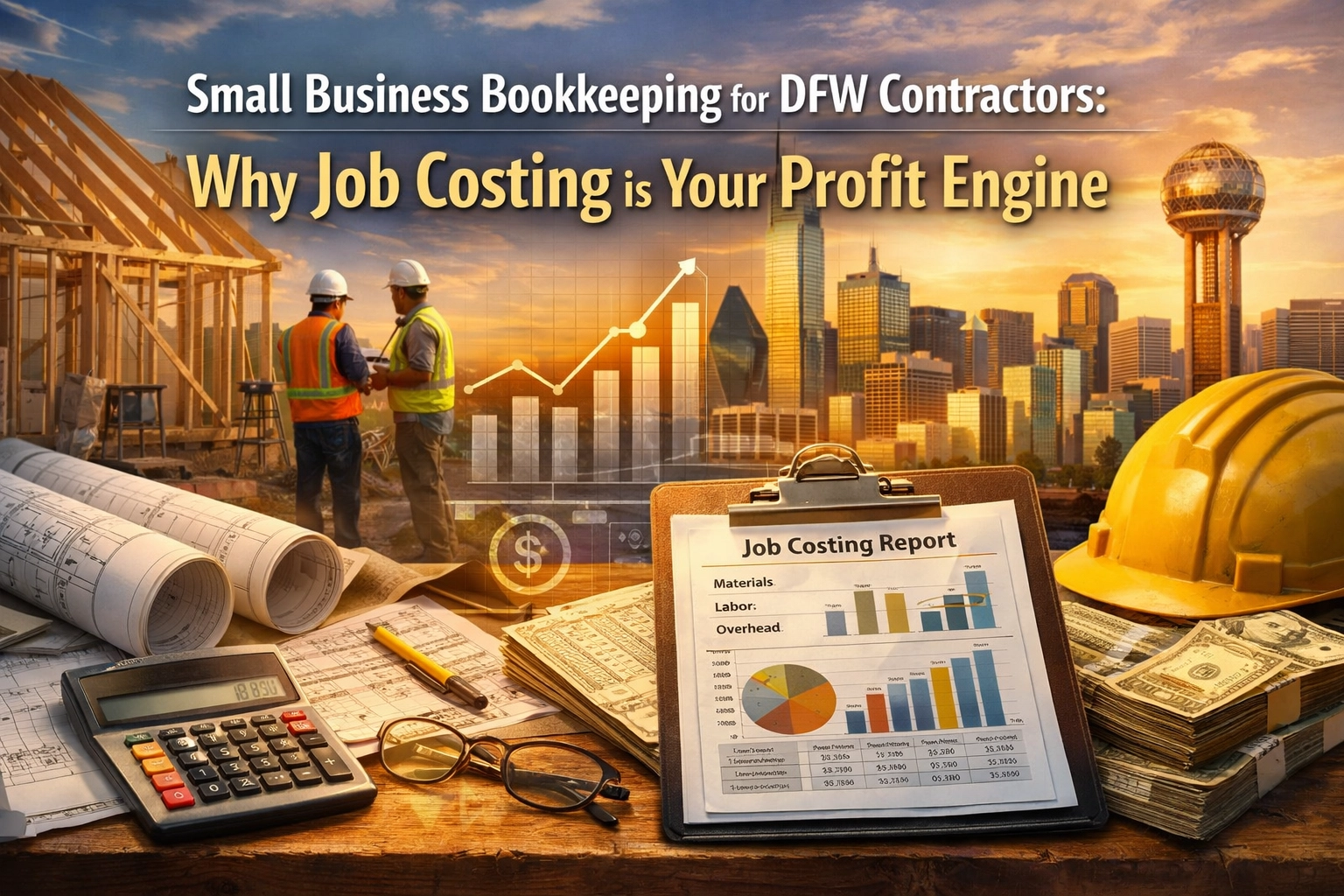
Small Business Bookkeeping for DFW Contractors: Why Job Costing is Your Profit Engine
In the booming construction landscape of Dallas-Fort Worth, there is no shortage of work. From the residential expansions in Frisco to the commercial revitalization in downtown Fort Worth, cranes and trucks are a permanent fixture of our skyline. For many contractors, revenue isn't the problem, profitability is.
If your trade business is generating upwards of $200,000 in annual revenue but you find yourself wondering where the cash went at the end of every month, you likely have a bookkeeping problem, not an operations problem. Specifically, you may be missing a "profit engine" known as job costing.
At AG Freideman Tax & Accounting Firm, we work with S-Corps, partnerships, and multi-member LLCs across the DFW Metroplex. We have seen firsthand that generic bookkeeping is the fastest way for a successful contractor to lose their shirt. To truly scale, you need small business bookkeeping services that treat every project as its own individual business.
What is Job Costing and Why Does It Matter?
Standard bookkeeping tells you how much money you spent on fuel, materials, and labor across your entire company for the month. Job costing, however, breaks those expenses down project by project. It allows you to see exactly which jobs are padding your bank account and which ones are draining it.
For a DFW contractor, this isn't just a "nice-to-have" feature; it is a survival mechanism. Whether you are an electrical subcontractor or a custom home builder, knowing your margins on a per-job basis allows you to:
- Identify Underperforming Projects: Stop the "bleeding" before a project is finished.
- Refine Future Bidding: Use historical data to stop under-quoting on labor or materials.
- Manage Cash Flow: Align your draws and progress billings with actual expenses incurred.
Without job costing, you are essentially flying blind through a North Texas thunderstorm. You might make it to the destination, but you’re taking unnecessary risks along the way.

The Three Pillars of Construction Bookkeeping
To build a functional profit engine, we focus on three core areas of bookkeeping that go beyond what generalist accounting firms in Dallas, TX typically offer.
1. Labor Burden: The Hidden Cost
Many contractors calculate their labor costs based solely on the hourly wage paid to their crew. This is a mistake. To find your true "labor burden," we must factor in payroll taxes, workers' compensation insurance, benefits, and even the cost of the tools they use.
In a high-growth market like Dallas, labor is expensive and competitive. If you are not factoring in the total cost of every hour spent on a job site in Arlington or Plano, your estimated 20% margin might actually be closer to 5% after overhead.
2. Real-Time Material Tracking
Material prices have been volatile over the last few years. A quote provided in January might be completely irrelevant by the time the lumber or copper hits the site in April. Our approach to bookkeeping ensures that material costs are tracked against specific job codes as soon as the invoice is received. This allows us to provide you with a "Budget vs. Actual" report mid-project, giving you the chance to adjust your strategy or discuss change orders with the client.
3. Subcontractor Management and Compliance
If you are a general contractor or a larger trade firm, your subcontractors are your lifeline. However, they are also a significant compliance risk. We help DFW contractors manage 1099 tracking, certificates of insurance (COI), and lien waivers. Proper bookkeeping ensures that you aren't just paying subs, but that you are documenting those payments correctly to avoid headaches during a Dallas CPA audit or tax season.
Moving Toward Professional Financial Reporting
For businesses crossing the $200,000 revenue mark, the "shoebox of receipts" method is no longer viable. You need professional financial statements that speak the language of construction.
When we provide virtual accounting services, we prioritize two specific reports for our contractor clients:
- The Work-in-Progress (WIP) Report: This is the most important document for any construction-based S-Corp or partnership. It shows whether you have over-billed or under-billed on each project. Over-billing can lead to a false sense of security (having cash that actually belongs to future expenses), while under-billing can lead to a sudden cash crunch.
- Profit & Loss by Job: Instead of seeing one giant number for "Materials," you see "Job #102: Kitchen Remodel – Materials." This level of granularity is what allows you to make data-driven decisions about which types of projects to pursue in the future.

Tax Planning and Entity Structure for DFW Contractors
Bookkeeping is the foundation, but tax planning is the roof that protects your assets. Most contractors in the Dallas-Fort Worth area operate as S-Corps to minimize self-employment taxes. However, as your revenue grows, the complexity of your tax obligations increases.
We often see contractors who are technically profitable but have zero cash because they haven't planned for their Franchise Tax Report filing or their quarterly estimated payments. In Texas, while we don't have a state income tax, the Franchise Tax can catch growing businesses off guard if their bookkeeping isn't structured to track "Cost of Goods Sold" (COGS) accurately.
By maintaining clean, job-costed books throughout the year, our team can perform proactive tax planning. We don't just tell you what you owe in April; we help you strategize in October. This might include:
- Accelerating equipment purchases (Section 179 deductions).
- Adjusting officer compensation to balance tax savings with IRS "reasonable salary" requirements.
- Ensuring all multi-member LLC or partnership agreements are reflected accurately in the distributions.
Why Location Matters: The DFW Advantage
Working with a local firm like AG Freideman means we understand the specific nuances of the North Texas economy. We know the difference between the municipal requirements in Dallas versus the rapidly developing suburbs of Collin County. We understand that your "office" is often a pickup truck on I-35, and you need accounting solutions that are mobile, cloud-based, and efficient.
We provide the "big firm" expertise of a Dallas CPA with the personalized, casual communication style that contractors appreciate. We don't hide behind jargon; we give you the facts you need to keep your crews working and your profit margins healthy.

The Path to Scalability
If you want to grow from a $250k revenue business to a $2M revenue business, you cannot do it by working harder. You have to work smarter. That starts with treating your financial data with the same respect you treat your blueprints.
Proper job costing turns your bookkeeping from a "necessary evil" into a profit engine. It gives you the confidence to say "no" to unprofitable jobs and "yes" to the projects that will actually build wealth for you and your family.
At AG Freideman Tax & Accounting Firm, we are here to handle the heavy lifting of your back office. From small business bookkeeping services to complex tax preparation, we ensure that your DFW contracting business is compliant, profitable, and ready for the next big project.
Take the Next Step for Your Business
Don't let another project go by without knowing your true margins. If you are ready to implement a job-costing system that actually works for your trade, we invite you to reach out. Let’s discuss how we can streamline your payroll, clean up your books, and put your profit engine in high gear.
Whether you need help with Texas Registered Agent services or a complete overhaul of your accounting system, our team is ready to help you build a stronger financial foundation here in Dallas-Fort Worth.