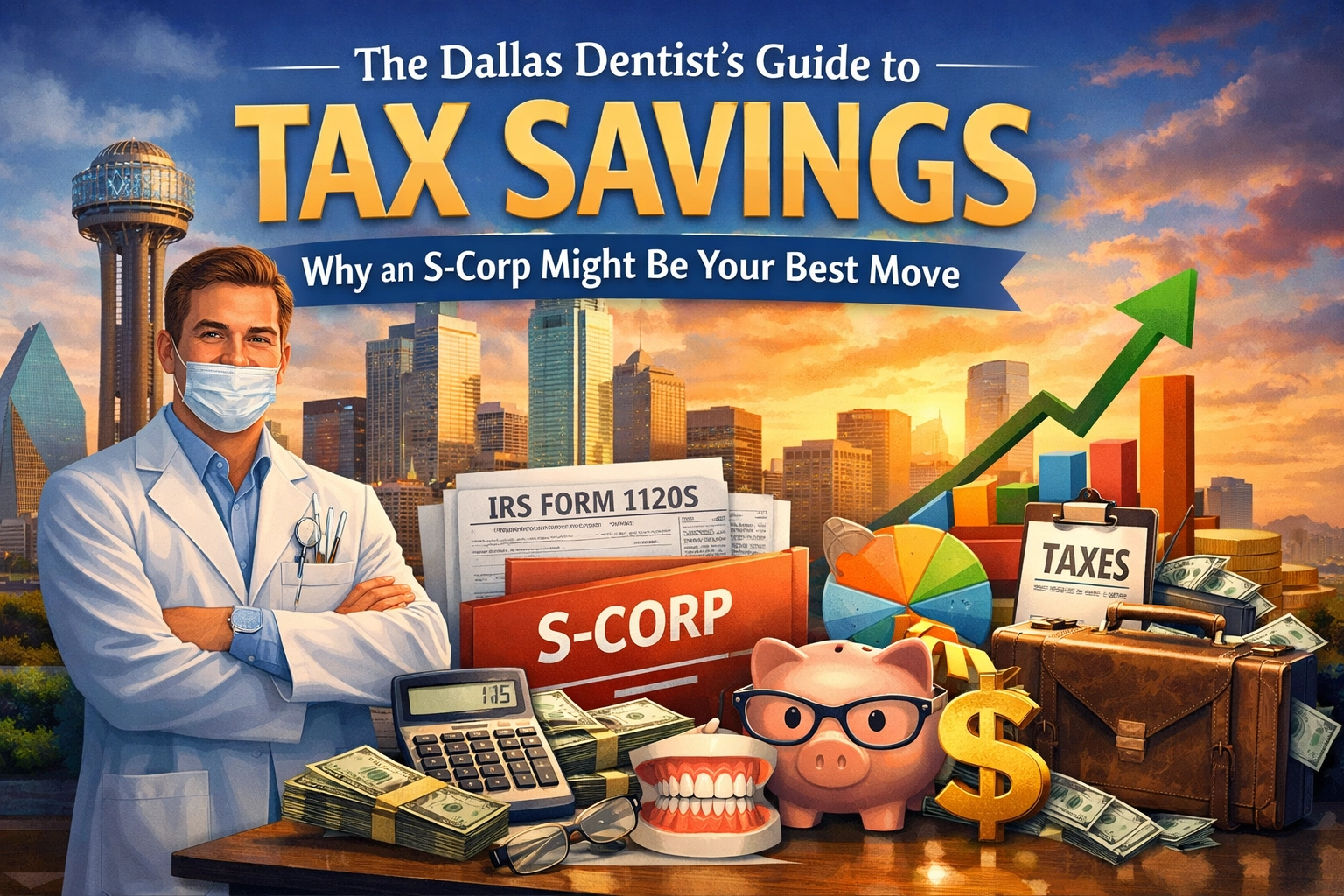
The Dallas Dentist’s Guide to Tax Savings: Why an S-Corp Might Be Your Best Move
The Dallas Dentist’s Guide to Tax Savings: Why an S-Corp Might Be Your Best Move
- The Problem: The 15.3% "Success Tax"
- Calculating the Savings for DFW Dental Practices
- The "Reasonable Salary" Requirement
- bookkeeping and payroll: The Backbone of Compliance
- Maximizing the QBI Deduction
- Retirement Planning and the S-Corp Strategy
- Texas-Specific Considerations: Franchise Tax and Compliance
- Why AG Freideman is the Choice for DFW Dentists
- Next Steps for Your Practice
The Problem: The 15.3% "Success Tax"
Most dental practices start as a Sole Proprietorship or a Single-Member LLC. From a legal perspective, this is a great starting point. However, from a tax perspective, it can become incredibly expensive as you become more successful.
When you operate as a standard LLC, the IRS views all of your practice’s net profit as "earned income." This means every dollar you earn is subject to self-employment tax, which currently sits at 15.3% (covering Social Security and Medicare). For a dentist netting $250,000, this tax alone can be staggering.
This is where the S-Corp election becomes a game-changer. By electing S-Corp status, we can help you split your income into two categories:
- A Reasonable Salary: This is paid via W-2 and is subject to payroll taxes.
- Shareholder Distributions: This is the remaining profit, which is passed through to you without being subject to the 15.3% self-employment tax.

Most dental practices start as a Sole Proprietorship or a Single-Member LLC. From a legal perspective, this is a great starting point.
Calculating the Savings for DFW Dental Practices
To understand the impact, let’s look at a practical example for a high-earning dentist in Dallas.
Imagine your practice generates $300,000 in net profit after all overhead: chairs, hygienist salaries, and supplies: is paid.
- As a standard LLC: You would owe self-employment tax on nearly the entire $300,000. While there are caps on the Social Security portion, the Medicare portion (2.9% or more) continues indefinitely. You could easily be looking at over $40,000 in self-employment taxes alone before you even touch your federal income tax.
- As an S-Corp: We work with you to determine a "reasonable salary." Let’s say that salary is $150,000 based on DFW market rates for a dental director. You pay payroll taxes on that $150,000. The remaining $150,000 is taken as a distribution. That second $150,000 is not subject to the 15.3% tax, potentially saving you upwards of $20,000 per year.
These savings aren't just theoretical; they are a direct result of specialized tax preparation services in Dallas that prioritize proactive planning over reactive filing.
The "Reasonable Salary" Requirement
The IRS is well aware of the S-Corp strategy, which is why they require S-Corp owners to pay themselves a "reasonable salary." You cannot pay yourself $20,000 and take $280,000 in distributions if you are working full-time in the practice.
As your CPA in Dallas, our role is to help you document and justify what a reasonable salary looks like for a dentist with your experience and production level in the North Texas market. We look at labor statistics and local benchmarks to ensure your s corp tax filing remains compliant while maximizing your take-home pay.
bookkeeping and payroll: The Backbone of Compliance
Transitioning to an S-Corp isn't just a box you check on a form; it changes how you interact with your practice's finances. You can no longer just "draw" money out of the business bank account whenever you need it. You are now an employee of your own corporation.
This requires:
- Rigorous Bookkeeping: You need clean, monthly financial statements to track your distributions accurately.
- Payroll Integration: You must run formal payroll to handle tax withholdings (Federal, Social Security, and Medicare).
- Entity Tax Returns: Unlike a single-member LLC, an S-Corp must file its own tax return (Form 1120-S) and provide you with a Schedule K-1.
Many dentists find this administrative burden daunting. This is why we offer virtual accounting services specifically designed for medical and dental professionals. We handle the back-office complexity so you can stay focused on patient care.

Maximizing the QBI Deduction
A significant piece of the tax puzzle for dentists is the Qualified Business Income (QBI) deduction, which allows many business owners to deduct up to 20% of their qualified business income from their taxes.
However, for dental practices (which are considered "Specified Service Trades or Businesses" or SSTBs), this deduction begins to phase out once your taxable income hits certain thresholds. Strategic income tax return preparation for individuals and business entities involves balancing your W-2 salary with your distributions to ensure you are squeezing every possible cent out of the QBI deduction before the phase-out limits apply.
Retirement Planning and the S-Corp Strategy
One of the most overlooked benefits of an S-Corp structure is the ability to supercharge your retirement savings. By structuring your W-2 salary correctly, we can implement high-contribution retirement plans like a 401(k) or a Cash Balance Plan.
For high-earning dentists in their peak earning years, these plans allow you to shield hundreds of thousands of dollars from taxes while building a significant nest egg. This level of planning requires a deep understanding of both federal income tax preparation and specialized entity tax rules.
Texas-Specific Considerations: Franchise Tax and Compliance
Operating in the Dallas-Fort Worth area means we also have to account for Texas-specific requirements. While Texas has no state income tax, S-Corps are still subject to the Texas Franchise Tax.
Furthermore, every Texas corporation is required to maintain a Registered Agent. For many of our clients, we provide Texas Registered Agent services to ensure that all legal correspondence and compliance notices are handled professionally and privately, keeping your practice's home office address off public records.

Why AG Freideman is the Choice for DFW Dentists
At AG Freideman Tax & Accounting Firm, we don't just "do taxes." We serve as your outsourced CFO and advisory team. We understand that a dental practice with revenue over $200k has different needs than a retail shop or a freelance consultant.
Our approach to tax preparation services in Dallas is built on three pillars:
- Compliance: Ensuring your franchise tax report filing and federal returns are bulletproof.
- Strategy: Implementing S-Corp elections, QBI optimization, and retirement plan integration.
- Communication: Keeping you informed of how your practice is performing through accurate bookkeeping and regular consultations.
Whether you are a general dentist in Plano, an orthodontist in Southlake, or an oral surgeon in Downtown Dallas, your tax strategy should be as precise as your clinical work.
Next Steps for Your Practice
If your practice is netting over $200,000 and you are still operating as a simple LLC or sole proprietorship, you are likely overpaying the IRS. The transition to an S-Corp requires careful planning and precise execution, but the long-term financial benefits are undeniable.
We invite you to reach out for a consultation. We can review your most recent tax preparation for 2022 or current filings and show you exactly where an S-Corp election could put money back into your practice.
Don’t let 15.3% of your hard-earned profit disappear to self-employment taxes. Let’s build a structure that supports your growth and protects your income.
Ready to optimize your dental practice's tax strategy? Contact AG Freideman Tax & Accounting Firm today to discuss our specialized services for DFW dental professionals.

Ready to Get Started?
Book your free consultation with Al Freideman, CPA. 30+ years experience serving Dallas-Fort Worth.