
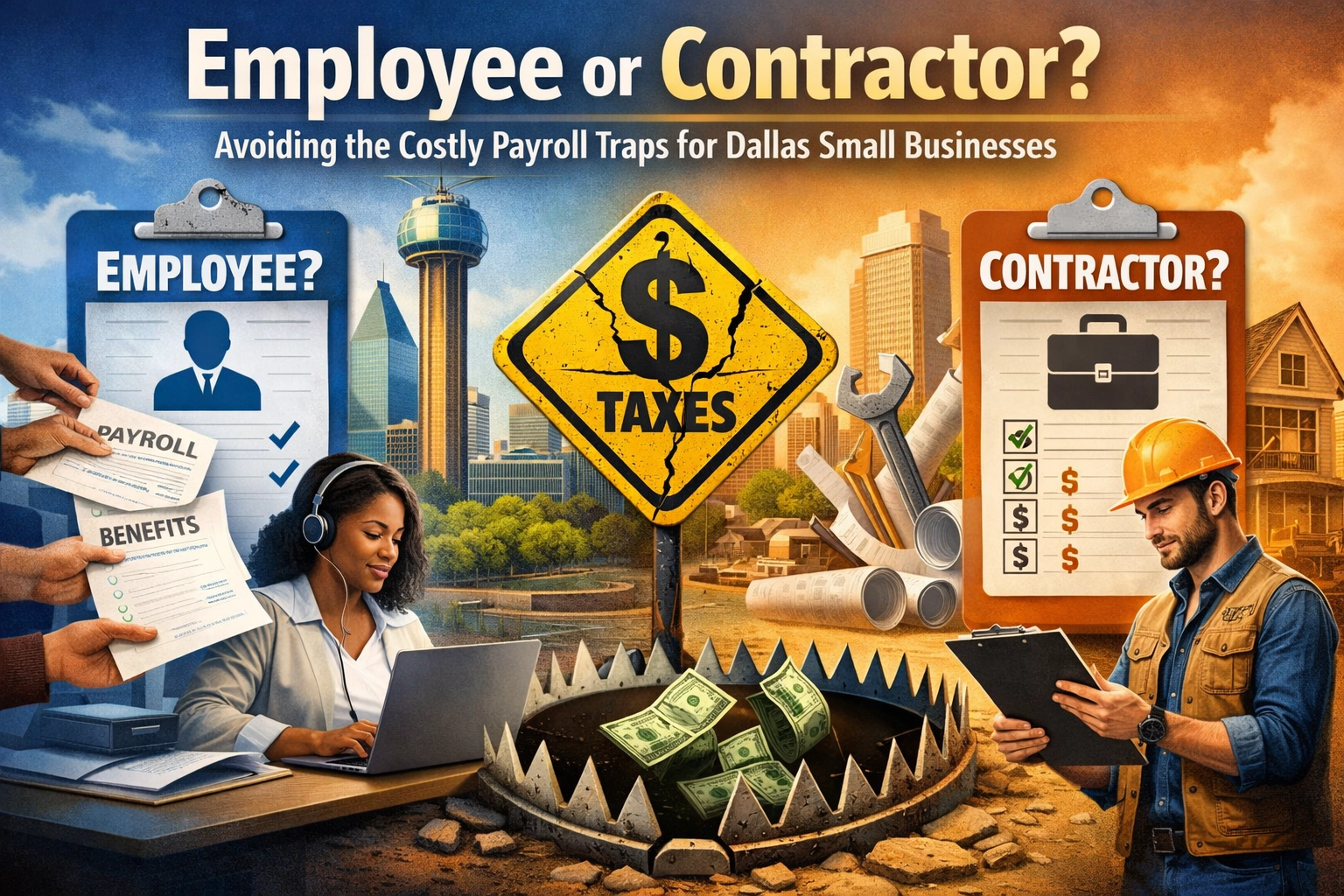
Employee or Contractor? Avoiding the Costly Payroll Traps for Dallas Small Businesses
For many Dallas small business owners, especially those in the fast-paced construction, HVAC, and professional service sectors, the temptation to label everyone a "1099 contractor" is strong. It seems simpler on the surface: no payroll taxes, no workers' comp, and significantly less paperwork. However, this shortcut is one of the most dangerous financial traps a Texas business can fall into.
At AG Freideman Tax & Accounting Firm, we have seen firsthand how a single audit from the Texas Workforce Commission (TWC) or the Department of Labor (DOL) can derail a thriving local company. The distinction between an employee and an independent contractor isn't just a matter of preference or a signed agreement: it is a legal determination based on the reality of the working relationship.
In this guide, we will break down the complex web of state and federal rules so you can protect your business and stay focused on growth.
Why the "Contractor" Label Is Often a Trap
In the Dallas-Fort Worth metroplex, competition is fierce. To keep bids low, some businesses attempt to avoid the "burden" of payroll. But misclassification is not a victimless clerical error in the eyes of the government. If the IRS or TWC determines your "contractors" are actually employees, you could be held liable for:
- Unpaid federal and state payroll taxes (going back years).
- Unpaid overtime and minimum wage claims under the Fair Labor Standards Act (FLSA).
- Massive penalties and interest.
- Unpaid workers' compensation premiums.
- Backdated employee benefits.
The financial exposure often far exceeds the "savings" gained by avoiding a proper payroll system. This is why partnering with a knowledgeable Dallas CPA and utilizing professional payroll services for small business is a strategic investment in your company’s survival.

The Texas Standard: The "Right to Direct or Control" Test
The Texas Workforce Commission (TWC) uses a common-law test focused primarily on one question: Does the business have the right to direct or control the details of how the work is performed?
It does not matter if you have a written contract stating the worker is an independent contractor. If the reality of the work looks like employment, the TWC will treat it as such. Here are the key factors they evaluate:
- Instructions and Training: If you provide specific instructions on when, where, and how to work, or if you provide training on particular methods, the worker is likely an employee. Real contractors are expected to bring their own expertise to the table without your guidance on the "how."
- Integration into the Business: Is the worker’s service a core part of your business? For a Dallas construction firm, a plumber hired for a specific job might be a contractor. However, a site supervisor who works only for you and manages your daily operations is almost certainly an employee.
- Tools and Equipment: Generally, employees use tools provided by the employer. True independent contractors invest in their own equipment, vehicles, and insurance.
- Payment Structure: Employees are typically paid by the hour, week, or month. Contractors are usually paid by the job or through a competitive bid process.
- Exclusivity: Does the worker have the freedom to work for other Dallas businesses? If you prevent them from taking other jobs, the TWC views them as economically dependent on you: a hallmark of employment.
The Federal Shift: The DOL’s 2024 Six-Factor Test
While the Texas rules are vital, Dallas business owners must also contend with federal standards. As of March 11, 2024, the U.S. Department of Labor implemented a new "Economic Reality" test. Unlike previous versions that prioritized "control," this new rule gives equal weight to six different factors:
- Opportunity for Profit or Loss: Can the worker increase their earnings through their own managerial skill, marketing, or negotiation? If they only earn what you pay them for their time, they are likely an employee.
- Investment by the Worker and the Employer: Is the worker making capital investments (like buying a specialized van or expensive software) that are "business-like" in nature?
- Permanence of the Relationship: Is the work sporadic or project-based? Long-term, indefinite relationships strongly suggest employee status.
- Nature and Degree of Control: This includes your control over their schedule, their ability to work for others, and your right to supervise their performance.
- Integral Nature of the Work: If the work is "critical, necessary, or central" to your business’s primary offering, the DOL leans toward classification as an employee.
- Skill and Initiative: Does the worker use specialized skills to perform the work? More importantly, do they use those skills in a "business-like" way to move the needle on their own career?

The "Contract" Myth: Why Paperwork Isn't a Shield
A common misconception among Dallas entrepreneurs is that a signed "Independent Contractor Agreement" protects them from audits. We must be clear: The IRS and TWC do not care what you call the relationship; they care how the relationship functions.
If you hire a "contractor" to answer your phones from 9 AM to 5 PM at your Dallas office, provide them with a desk and computer, and pay them a set weekly rate, a signed contract saying they are a "consultant" will not hold up in an audit. They are an employee.
This is where many payroll firms in dallas texas fail their clients: they simply process whatever data the owner provides without flagging these glaring red flags. At AG Freideman, we take a more proactive approach. We help you evaluate your workforce structure before the regulators come knocking.
Specific Risks for Dallas Construction and Service Firms
In the DFW area, the construction industry is under a microscope. The TWC is well aware that misclassification is rampant on job sites.
For example, if you hire a crew of dry-wallers and provide the materials, the scaffolding, and the daily schedule, those individuals are likely your employees. If you hire a professional drywall company that brings their own crew, their own tools, and provides you with a Certificate of Insurance, they are independent contractors.
Misclassifying a whole crew can lead to hundreds of thousands of dollars in back-owed taxes and penalties. If a worker gets injured on a Dallas job site and you haven't provided workers' comp because you labeled them a "contractor," your entire business could be at risk of a devastating lawsuit.

How AG Freideman Helps You Stay Compliant
Navigating these rules while trying to run a business is exhausting. Our goal is to take the guesswork out of your operations. We offer comprehensive payroll services for small business that go beyond just cutting checks.
When you work with our team, we provide:
- Classification Guidance: We help you apply the TWC and DOL tests to your specific situation so you can make informed hiring decisions.
- Seamless Payroll Processing: We handle the withholding, filing, and reporting of all federal and Texas payroll taxes, ensuring you never miss a deadline.
- Compliance Monitoring: As labor laws change at the state and federal levels, we keep you informed so your business can adapt quickly.
- Integration with Tax Planning: Because we are a full-service Dallas CPA firm, we ensure your payroll data flows perfectly into your year-end tax preparation, maximizing your deductions while maintaining total compliance.
Transitioning from 1099 to W-2
If you realize today that you have misclassified workers, don't panic: but do act. Transitioning workers from 1099 to W-2 status can be handled delicately to minimize past exposure while fixing the problem moving forward.
We can help you calculate the costs of this transition and set up a robust system that protects your business from future audits. You can learn more about our specific approach to business filings and compliance on our blog.
Secure Your Business Future Today
The "Dallas hustle" is about working hard and growing fast, but it shouldn't involve taking unnecessary risks with the IRS or the Texas Workforce Commission. Proper worker classification and a reliable payroll system are the foundations of any scalable business.
At AG Freideman Tax & Accounting Firm, we pride ourselves on being more than just "number crunchers." We are your partners in compliance and growth. Whether you are just starting out and need business formation services or you are an established Dallas firm looking to professionalize your payroll, we are here to help.
Ready to clean up your payroll and protect your business?
Contact us today for a consultation. Let’s make sure your business is built on a solid, compliant foundation so you can get back to what you do best( serving your customers in the Great State of Texas.)

Ready to Get Started?
Book your free consultation with Al Freideman, CPA. 30+ years experience serving Dallas-Fort Worth.